


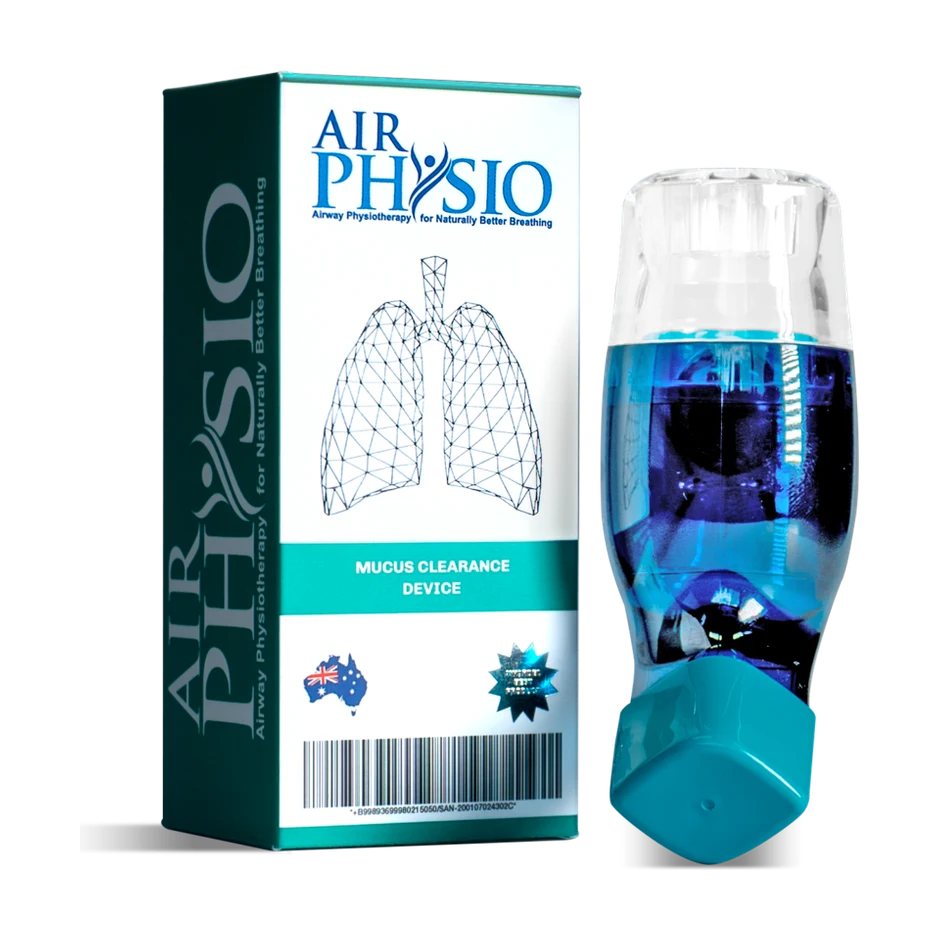
What it is
The AirPhysio holds a stainless steel ball inside a cone. When you breathe out through it, the ball lifts and drops back rapidly, creating positive pressure plus vibration in your airways. The pressure keeps the airways open and the vibration loosens mucus so it can move up and out.
The resistance comes from the steel ball itself. We stock two versions: Low Lung Capacity, with a lighter ball for children, people with weaker breathing muscles or more severe lung conditions, and Average Lung Capacity, with a medium ball for people with reasonable fitness or a mild to moderate lung condition. Your physiotherapist will match the right one to you.
Who it's for
- Asthma, COPD, emphysema and bronchiectasis.
- Recovery from a cold, flu or chest infection.
- After surgery, including chest and abdominal surgery, to help re-expand the lungs.
- People with weak breathing muscles, and active people wanting to clear their airways before exercise.
How to use it
Sit or stand upright. If you use an inhaler or nebulised medication, AirPhysio notes the device can be used afterwards to help spread the medication through your lungs.
- Take a deep breath in through your nose, using your diaphragm so your belly moves out, and fill your lungs.
- Hold your breath for 2 to 3 seconds.
- Put the device in your mouth, seal your lips, and breathe out through it at a reasonably fast but steady pace for 3 to 5 seconds. Don’t force every last bit of air out.
- Tilt the device up or down slightly until you feel the strongest vibration in your chest. Keeping your cheeks firm rather than puffed out makes the vibration stronger.
- Cough when mucus comes up. There’s no need to cough after every breath: wait until you feel it move.
- Repeat about twice a minute for up to 5 minutes, taking two normal breaths in between to avoid getting lightheaded.
Choosing a setting
- The ball bearing sets the resistance, and the balls are interchangeable between AirPhysio devices.
- Most people start with the Low Lung Capacity version and move up to Average as their breathing gets stronger, on your physiotherapist’s advice.
- If you feel lightheaded, you’re blowing too hard or too often. Slow down and take normal breaths between repetitions.
Cleaning & care
After each use
- Take the device apart.
- Wash the parts in tap water with a mild soap or detergent.
- Rinse every part with clean tap water.
- Dry with a clean towel, then reassemble and store somewhere clean and dry.
Weekly deep clean
- For a more thorough clean, AirPhysio suggests wiping or rinsing the already-cleaned parts with 60–90% ethyl or isopropyl alcohol.
- Let everything dry completely before putting it back together.
- AirPhysio does not publish a boiling, dishwasher or steam-sterilising method for this device, so don’t assume instructions from other devices apply.
Avoid: boiling or putting it through the dishwasher unless AirPhysio’s own instructions say you can.
When to replace it
AirPhysio says the device is expected to last up to two years with normal use. Replacement ball bearings are available separately. Replace it sooner if it’s cracked, if the ball sticks, or if it stops producing a good vibration.
Things to be careful about
- Not suitable if you have an untreated pneumothorax (collapsed lung), active tuberculosis, right-sided heart failure, a perforated eardrum or another middle ear problem, or have had oesophageal surgery.
- Don’t blow too hard or too fast. AirPhysio warns this can overwork your breathing muscles.
- Feeling lightheaded means you’re clearing too much carbon dioxide. Stop, breathe normally and rest before continuing.
- Check with us first if you’ve recently had surgery of any kind.
Sources: AirPhysio user’s guide · AirPhysio low lung capacity model. Instructions are summarised from the manufacturer and may change; always keep the leaflet that comes with your device.